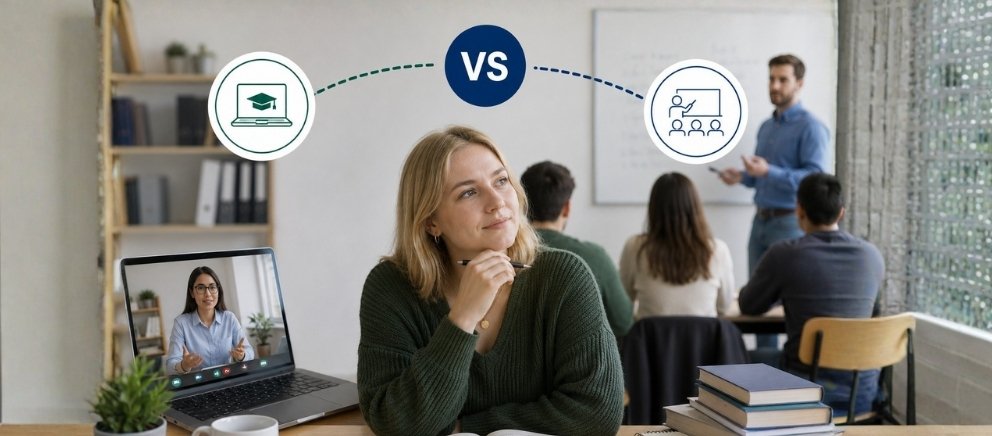
Online Courses vs Classroom Courses: Which Is Better?
If you’ve been putting off learning a language because you can’t picture squeezing a classroom commute into your week, you’re not alone. It’s one of the most common reasons people delay getting started, and it’s also one of the easiest to solve. At Lingua Learn Lithuania, we hear this from prospective students all the time, and the real question isn’t whether you have time; it’s whether online courses or classroom courses fit the life you actually have.
Both formats can get you fluent. The difference is in how they get you there, and which one you’ll actually stick with. Let’s break it down.
Online courses have moved a long way past the old idea of a pre-recorded video and a quiz at the end. Good online courses, the kind built around live sessions with a real instructor, give you the same structure and feedback as a classroom, minus the commute. You log in, you speak, you get corrected in real time, and then you close the laptop and get on with your day.
Research bodies like the OECD have tracked how far online and blended learning have come as formats, showing that structured, instructor-led online courses translate well beyond the physical classroom. The flexibility is the real draw here: you can take a lesson before work, during a lunch break, or late in the evening, whatever actually fits your schedule instead of someone else’s timetable. For learners juggling a full-time job, kids, or a schedule that shifts week to week, that flexibility alone can be the difference between starting online courses and putting them off indefinitely.
There’s something to be said for the energy of a physical classroom, and it’s worth weighing honestly against online courses before you choose. Sitting across from an instructor and classmates creates a kind of accountability that’s harder to replicate on a screen, and the social pressure of a scheduled, in-person session can push some learners to show up consistently in a way that a login link doesn’t.
Group dynamics also matter. Practicing with classmates who are at your level, stumbling through the same grammar points, can be motivating in a way that solo study rarely is. Education researchers, including those cited by UNESCO, have noted that in-person settings can support concentration and social motivation in ways that online courses sometimes struggle to replicate, especially for learners who focus better with fewer distractions around them.
Classroom learning also has a built-in sense of routine. Walking into a physical space and closing your laptop for the evening creates a clear boundary between “learning time” and everything else, a boundary that online courses ask you to build for yourself.

Honestly, it depends less on which format is “better” and more on which one matches how you actually learn and live. If your schedule is unpredictable, if you travel for work, or if you simply don’t have a language school nearby, online courses solve a real logistical problem without sacrificing the quality of instruction. If you thrive on in-person energy and have a classroom option that fits your calendar, that works too.
What actually matters more than the format is the quality of the instruction inside it. Well-run online courses with a qualified, native-speaking teacher will get you further than an unstructured in-person group with no clear curriculum, and the reverse is just as true. The format is the delivery method; the teaching is what builds the skill. A skilled instructor adjusts to your pace, corrects your mistakes in the moment, and keeps you accountable regardless of whether you’re sitting across a table or logging into online courses from your kitchen.
There’s no wrong answer here, just the one that’s honest about how you actually work.
The good news is you don’t have to guess. Lingua Learn Lithuania offers live, instructor-led online language courses designed to give you all the structure and feedback of a classroom, minus the commute. Whichever format you lean toward, the fastest way to find out is to try a real lesson and see how it feels.
Ready to get started? Browse our full range of online language courses and find the one that fits how you actually live and learn.