

Language levels can feel like a secret code the first time you see a course listed as “B1” or “C1” with no explanation of what that actually means for you. Picking the wrong one means either sitting through material you’ve already mastered or drowning in content way above your head. Understanding how language levels actually work makes choosing a course and tracking your own progress a lot less confusing.
Most language schools, including ours, measure language levels using the Common European Framework of Reference for Languages, usually just called CEFR. It’s an internationally recognized system that breaks language ability into six clear levels, from A1 (complete beginner) to C2 (near-native mastery). Instead of vague labels like “beginner” or “advanced,” which can mean wildly different things depending on who’s using them, CEFR gives you consistent, comparable language levels no matter where in the world you’re learning.
This matters more than it might seem. A course labeled “intermediate” at one school might be a completely different level at another. CEFR removes that guesswork.
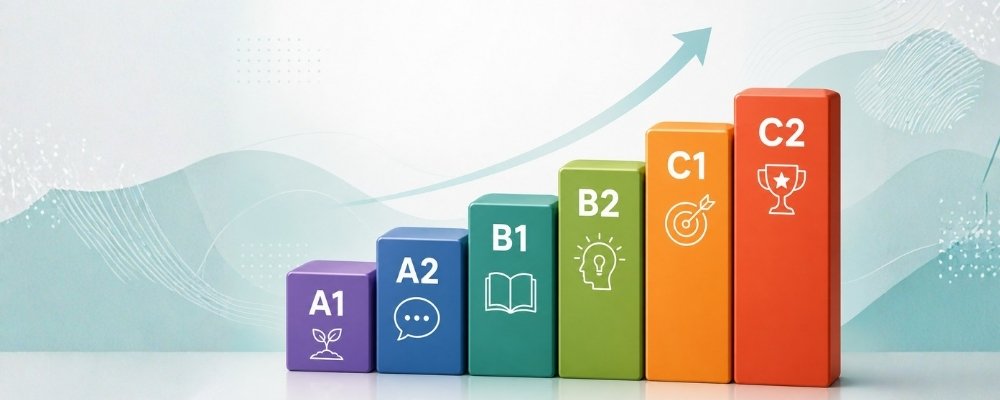
At A1, you’re building the basics: simple greetings, introducing yourself, ordering food, and asking for directions. You can understand and use familiar everyday expressions, but conversations still require the other person to speak slowly and clearly.
By A2, you can handle short, simple exchanges about familiar topics, your job, your family, and your routine. You’re still relying heavily on memorized phrases, but you’re starting to string sentences together more naturally.
This is often considered the first “functional” language level. At B1, you can deal with most situations you’d encounter while traveling, describe experiences and opinions, and follow the main points of a conversation on familiar topics, even if you still make noticeable mistakes.
At B2, you can hold a conversation with a native speaker without much strain on either side. You can understand the main ideas of complex texts, discuss a wide range of topics, and express your viewpoint on most issues with reasonable fluency.
C1 speakers can express themselves fluently and spontaneously without obviously searching for words. You can use the language flexibly for social, academic, and professional purposes, and understand a wide range of demanding, longer texts.
C2 is the top of the CEFR scale, and the highest of all language levels. At this level, you understand virtually everything you hear or read, express yourself precisely in complex situations, and can distinguish finer shades of meaning even in nuanced or unfamiliar contexts. Very few non-native speakers reach this level, and it’s rarely required outside specific professional or academic settings.
Picking a course above your actual level is one of the most common reasons people quit learning altogether. It’s demoralizing to feel constantly lost, and it’s just as unproductive to sit through material you’ve already mastered. Research on English proficiency backs this up in a very concrete way: studies cited by IELTS found that language proficiency level is one of the strongest predictors of how well students cope in real academic settings, directly affecting how easily they follow lectures, how much time and effort they need to grasp content, and how much frustration or anxiety they experience along the way.
That same mismatch shows up outside university lecture halls, too. Many learners overestimate their level in areas like grammar and underestimate it in speaking, or vice versa, which is exactly the kind of gap a structured evaluation of your language level catches early, before it turns into weeks of frustration in the wrong course.
Language levels aren’t just useful for picking a course; they’re a practical way to measure your own growth over time. Instead of a vague sense of “I think I’m getting better,” you can point to concrete milestones: moving from A2 to B1 means you can now follow conversations at a normal pace; moving from B1 to B2 means you can finally argue your point in a debate without translating in your head first.
Setting your next language level as a goal, rather than a vague target like “fluency,” makes progress measurable and keeps motivation from fading halfway through.
Not sure where your language levels currently stand? The best way to find out is a proper assessment rather than a guess. Take a look at Lingua Learn Lithuania’s full range of language courses to find a program structured around CEFR levels, or check out our English language course to see exactly how Lingua Learn Lithuania applies these levels from your very first lesson to fluency.