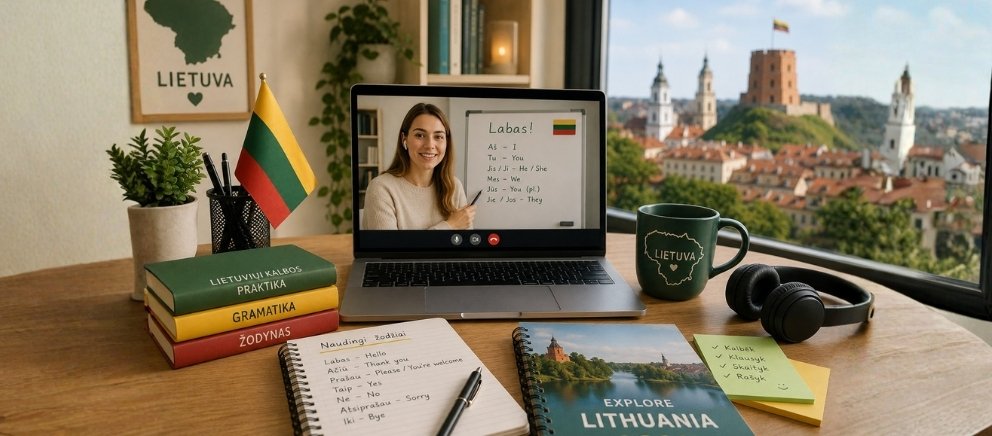
If you’ve ever heard someone describe the Lithuanian language as a “living fossil,” they weren’t exaggerating for effect. Linguists genuinely treat it as one of the closest living links to the ancient roots of the entire Indo-European language family, the same family that gave us English, Spanish, Hindi, and dozens of others. For anyone moving to Lithuania, marrying into a Lithuanian family, or just curious about a language that sounds like nothing else in Europe, here’s what you actually need to know.
The Lithuanian language belongs to the East Baltic branch of the Indo-European family, and it has exactly one living relative: Latvian. Every other Baltic language, including Old Prussian, died out centuries ago, leaving these two standing alone as the last members of their branch.
Where languages like English shed most of their old grammar over the centuries, the Lithuanian language held onto sounds and structures that even Latin and Ancient Greek eventually lost.
If you want to see exactly how it’s classified alongside the world’s other languages, Ethnologue has a solid breakdown of its family tree and speaker distribution. Around three million people speak the Lithuanian language as a first language today, mostly in Lithuania, with meaningful communities in the US, UK, Ireland, and Poland from waves of emigration over the last century.
The oldest surviving piece of written Lithuanian is a prayer from 1503, though people were speaking the Lithuanian language long before anyone wrote it down. For a long stretch of history, Polish, German, and later Russian were the languages of government and formal life in the region, while Lithuanian survived mainly through everyday use in villages, which is a big part of why it stayed so close to its ancient roots.
The 19th century brought a national revival that pushed to standardize the Lithuanian language into the version spoken today, unifying dialects into the form taught and spoken across the country now.
The Lithuanian alphabet uses the Latin script and has 32 letters: 12 vowels and 20 consonants. A few things to expect right away:
The upside is real: Lithuanian spelling is almost entirely phonetic. Once you learn what each letter and diacritic sounds like, you can read new words out loud with confidence, something English speakers rarely get to say about their own language.

This is where the Lithuanian language earns its reputation. It’s highly inflected, meaning word endings shift depending on grammatical role:
The case system is the biggest hurdle for most learners, and it takes real repetition to internalize. It’s a logical system, though, not a random one. Once the patterns click, you’re applying a rule, not memorizing endless exceptions. Learners who study the Lithuanian language with a structured, level-by-level approach usually find that it becomes second nature faster than expected.
People rarely pick up the Lithuanian language by accident. The most common reasons include relocating for work or family, reconnecting with Lithuanian heritage a generation back, or a genuine fascination with a language this close to its ancient origins, a pattern backed up by research on what actually drives foreigners to learn the Lithuanian language. There’s a practical bonus too: because so few foreigners speak the Lithuanian language, even basic conversational Lithuanian tends to open doors and build goodwill fast. Locals notice, and they appreciate the effort.
Self-study apps can teach you vocabulary, but a grammar system this detailed is much easier to absorb with a real instructor guiding you through it, correcting your case endings before bad habits set in. Join a live, CEFR-aligned Lithuanian language course with Lingua Learn Lithuania, taught by native instructors, with flexible group and private class options for complete beginners through advanced learners. Still deciding between languages?
Browse our full lineup of adult courses at Lingua Learn Lithuania and enroll today. Your first real conversation in the Lithuanian language is closer than you think.